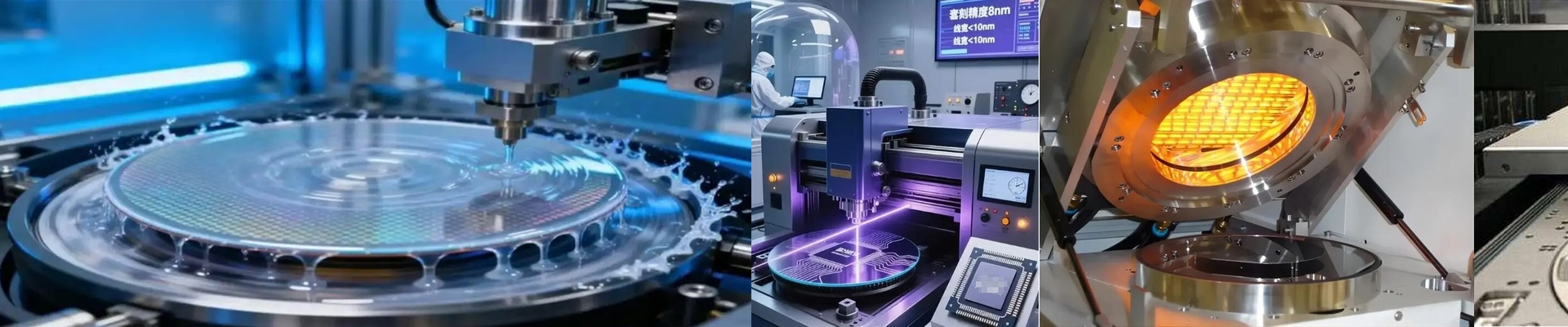
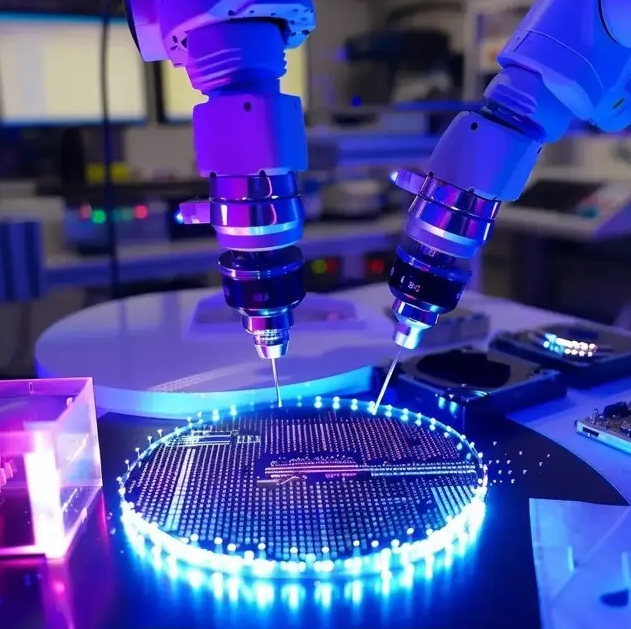
On the lithography floor, a 300 mm wafer flows from coat to bake in lockstep with the line’s takt. Soft bake at 90 °C, hard bake at 110 °C. The photoresist has to behave the same way, lot after lot. When the thermal profile drifts, you pay for it on the spot: CD shift, poor adhesion, bridge defects—then rework. The heater isn’t just another box in the background. It’s the control knob on the photoresist thermal budget. Optical wafer processing heaters are built for that control. They deliver fast, low-contact or non-contact heating with tight uniformity and repeatability, so the bake step doesn’t turn into a source of variability.
What matters, technically
In optical wafer processing, the heat usually comes from short-wave or medium-wave infrared—think quartz-halogen lamp modules inside a reflector cavity. You pick the wavelength to match the absorption of the photoresist and the layers underneath, so the energy lands where it’s needed, fast, without heating the whole mechanical stage. Thermal uniformity is the first spec you should be staring at. Across a 300 mm wafer, we target ±0.1 °C at the photoresist surface, measured with a calibrated thermal wafer mapped on a dense grid. That’s not a slogan. It’s the number that directly cuts CD non-uniformity and tames edge-bead behavior. If the center runs 5 °C hotter than the edge, the resist flows differently and your critical dimension starts to drift. ±0.1 °C keeps the process honest. Temperature repeatability matters just as much. From run to run, the same setpoint has to land at the same actual temperature within ±0.2 °C. You get there with closed-loop control, using a calibrated sensor traceable to NIST, and a heater architecture that minimizes thermal hysteresis. In practice, that means fewer qualifications, fewer excursions, and a yield that stays steady. Cleanroom compatibility is table stakes. The heater has to live in Class 1 to Class 100 without adding particles. We use high-purity quartz, metal-halogen-free seals, and smooth surfaces with controlled radii. Internal airflow is shaped to avoid turbulence that can lift particles, and exhaust ports are arranged to keep air from washing back over the wafer. Particle generation is measured with aerosol counters during steady-state operation, and the system is specified to hold particle counts within the host tool’s baseline. Zero particle generation isn’t a tagline—it’s mechanical discipline. Any outgassing from polymers, any flaking from insulation, any loose fastener thread becomes a yield killer. Materials are chosen for low outgassing and thermal stability, and the assembly is validated for particle performance through thermal cycling. Reliability comes down to uptime and lamp life. Optical heater modules are built for 24/7 operation, with lamp life rated at 5,000+ hours when filament temperature and power delivery are kept stable. The electronics include over-temperature protection, lamp ignition interlocks, and fault diagnostics to prevent unplanned downtime. When a lamp hits end-of-life, the module is designed for quick replacement without breaking cleanroom containment. Photoresist bake precision is what you get when all of that comes together. Soft bake and hard bake are thermally short steps, but they set viscosity, solvent removal, and adhesion. Get the precision right and you cut scum, tighten profile control, and make the develop step more predictable. Process repeatability is the sum of uniformity, repeatability, and stability. If the heater holds setpoint within tolerance after a weekend restart, after preventive maintenance, and after a power glitch, the line runs without re-tuning. That’s the real cost of ownership.
Why it works in the fab
In wafer fabrication, the optical heater sits in the coater-bake module, right next to the spin coater and close to the develop track. The wafer arrives wet from coat, and the bake has to pull out solvent without skinning the surface. The heater needs to ramp quickly to setpoint, hold it uniformly, and ramp down without overshoot. Fast ramp-up shortens the bake step, which can boost throughput without compromising quality. The non-contact nature of optical heating reduces mechanical interaction—important when the wafer has fragile layers or patterned topography. The heater isn’t pressing on the wafer; it’s delivering energy straight to the resist. Thermal budget control is the quiet benefit. Every photoresist stack has a thermal budget: a temperature window where flow is sufficient, solvent leaves, and the resist profile stays vertical. Step outside that window and you lose CD control or induce stress that leads to delamination. An optical heater with tight uniformity and repeatability keeps you inside that window, consistently. Energy use is practical, too. Optical heaters are efficient because the energy is directed, not wasted heating up the stage. The lamps deliver power on demand, and the reflector cavity keeps losses low. In a fab running thousands of wafers per week, that efficiency translates into lower electrical draw and less cooling load. Yield protection is the most direct payoff. A heater that holds ±0.1 °C uniformity and ±0.2 °C repeatability cuts down split lots, rework wafers, and excursion investigations. The line runs with fewer stops, and the process window feels predictable.
The things you actually need to know
Optical wafer processing heaters aren’t plug-and-play in every tool. Integration demands attention in three areas. Start with the host equipment interface. The heater has to match the mechanical envelope, the exhaust coupling, and the sensor interface of the coater-bake track. Expect a retrofit to mean a short line stop and a re-qualification run. The payoff is stable bake profiles, but the install is not trivial. Then there’s cleanroom operating discipline. Even with low-outgassing materials, the heater has to be cleaned and maintained the way you would in Class 1–100. Use approved solvents, don’t touch optical surfaces, and stick to a preventive maintenance schedule that swaps seals and lamps before they hit end-of-life. Particle performance depends on how the unit is handled. And don’t overlook thermal mass and ramp control. Optical heaters can ramp fast, but the control loop has to be tuned to the wafer stack and the stage material. Some processes need a controlled overshoot to hit the bake window quickly; others need a slower ramp to avoid skinning. The heater should be configurable, and the setpoint profile should be adjustable inside the tool’s recipe manager. One more reality: lamps are consumables. Plan for spare modules. Even with 5,000+ hour life, a 24/7 fab will see replacements. Keeping a spare on the shelf prevents extended downtime. If your line is fighting bake-to-bake variability, edge bead that shifts lot to lot, or CD drift that traces back to temperature, the optical wafer processing heater is the lever to pull. It’s not a general-purpose heat source. It’s a precision instrument built for photoresist thermal control, engineered for cleanroom operation, and specified for the numbers that matter in lithography. We design it to one standard: the process has to hold. Every time.